The Heart of the Matter
Sarah Lewis and the Anatomy of a Grievance
For Kimball Education Association member Sarah Lewis, the drive to protect students traces back to her own experience as a struggling elementary student. She didn’t know she needed glasses until third grade, leaving her significantly behind in reading. But her fifth-grade teacher, Mrs. Holtz, refused to see her as a child who couldn’t learn.
“She really pushed me and got me into reading. My fifth-grade year is the year I made the leap from being a non-reader to a reader. And it’s because of her,” Sarah said.
That moment—of truly being seen—became the blueprint for how she shows up for her students.
“I’ve always said my job is to be an advocate for kids. They just want somebody to listen to them,” she said.
The Heart of an Educator
As a counselor, Sarah supports 504 plans, behavior plans and students carrying unseen trauma. She is often the person reminding educators of the realities their students bring with them. And despite the challenges, she beams when she talks about the daily joy students bring to her life.
“My job is for kids. I have a duty to make sure kids are safe,” she said, reflecting the heart of her 13-year career in education.
This year, her commitment to students pushed her into the very anatomy of the grievance process—filing one herself for the first time. The ordeal began when local law enforcement inadvertently revealed Sarah’s identity as the mandatory reporter in a suspected abuse case, an action that can carry legal consequences under Nebraska’s Child Protection Act (Neb. Rev. Stat. §28-711) and related confidentiality protections. That breach set off a chain of events that eventually led her superintendent and school board to introduce a school-wide directive that directly contradicted both state law requiring unhindered, immediate reporting of suspected abuse and federal guidelines safeguarding mandated reporting systems.
The Directive
A new procedure sent to staff required all child abuse hotline calls to be cleared through administration, with the superintendent holding the final, non-appealable say. Sarah knew immediately that it was not only inappropriate—it was illegal.
“As a school counselor, that impacts my job almost on a daily basis,” Sarah said. “We’re mandatory reporters.”
Before the directive went out to all staff, she had been given an early heads-up.
“I was made aware of the procedure before everybody else was, so first I called my NSEA Organizational Specialist Andrea Longoria right away.”
With Andrea's guidance and support, Sarah attempted an informal resolution, addressing her concern with administration directly. An informal resolution is always the recommended first step in any grievance procedure—but the directive was sent out anyway.
Anatomy of a Grievance
Once the procedure became public, Sarah decided to file a formal grievance.
Grievance procedures in Nebraska schools are legally required. State law—Neb. Rev. Stat. §79-826—implies the need for formal processes when addressing disciplinary actions involving certificated staff.
Federal civil rights laws such as Title VI, Title IX, Section 504 and the Age Discrimination Act also mandate grievance procedures for discrimination complaints. The Nebraska Department of Education further reinforces these requirements through its oversight and regulations, especially in special education and discrimination matters.
As Sarah moved forward, she relied on the key principles needed in the anatomy of a grievance. She knew she had to locate her district’s grievance policy and study it closely, because in this process every deadline mattered—one missed timeline meant an automatic denial. She also examined the negotiated agreement to understand what protections were firmly in contract and which board policies could shift without notice.
By grounding herself in the exact steps, timelines and expectations of the grievance procedure, she ensured that her actions were precise, timely and fully aligned with policy
“My grievance was denied all along the way—from the superintendent and the school board,” Sarah said.
Knowing Nebraska law requires mandated reporters to report directly, she filed a formal complaint with the Nebraska Department of Education after exhausting local procedures. Grievance systems exist for exactly this reason: to follow every step, create a record and escalate only when necessary.
The Quiet Victor
Even though Sarah’s grievance was denied at every level, her efforts were far from futile. In the end, the district quietly shifted course. The administration had previously insisted the directive would be included in the handbook—yet it was nowhere to be found.
“I do think my grievance was a reason they didn't make it an actual policy rather than just a procedure," said Sarah.
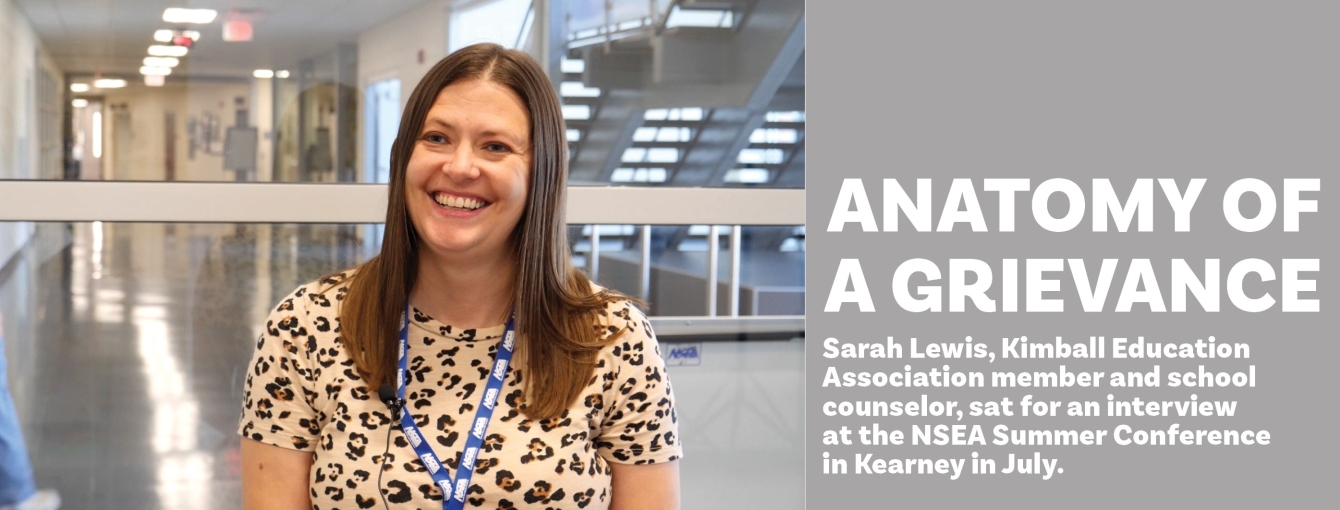
And the change didn’t end there. In September 2025, her superintendent sent an all-staff email instructing employees to stop following or referring to the directive altogether.During the NSEA Summer Conference in Kearney this past July, Sarah transformed her experience into purpose, leading a session alongside Andrea titled "The Anatomy of a Grievance" to show others exactly how the process works—and why it matters.
Throughout her journey, Sarah felt supported by her local and NSEA.
"Andrea was behind me whether I wanted to meet with administration one-on-one or whether I decided to file a grievance. I never felt alone,” said Sarah. “I am a member of NSEA because I want the support. I don’t want to do this alone.”
Sarah didn’t seek conflict, but she also didn’t shrink from her responsibility. She followed every step, upheld the law and reinforced the core purpose of grievance processes: to protect rights, ensure compliance and prevent harm.
Her story is one of courage, professionalism and clarity—but also of heart. One of the most important messages she hopes other educators take away from her story: you don’t have to navigate a grievance by yourself. NSEA Organizational Specialists are here to support members every step of the way. Members with questions may call NSEA headquarters at 402-475-7611 or toll-free at 800-742-0047 or send questions through the "Contact Us" feature of the NSEA website at www.nsea.org/contact-us.

New Educators
The New Generation of Educators in Nebraska (NewGEN) exists to drive early career educators towards success by fostering membership engagement, advancing teaching excellence through professional development, and creating a network of support through mentorship opportunities and classroom resources.

Join Now
NSEA is here for you. From professional growth opportunities and support, to amplifying your voice in public policy affecting you and your classroom, to providing perks like college debt assistance, NSEA has your future in mind. Learn more and join NSEA now.

The NSEA Children's Fund
NSEA established the Children's Fund in 1994 to fulfill modest and immediate needs of struggling students encountered daily by NSEA members in their workplaces. Find out how you can help a child today.
L.E.A.R.N — Providing valuable learning opportunities for educators: LearnNebraska.org Visit Website