Keeping Language Alive
Santee Education Association’s Krogman Preserves Language, Culture
In the final days of life, we do not reach for the things we learned last. We return to what found us first.
Before the lives we built for ourselves, before the lessons learned in classrooms and the jargon picked up in workplaces, there are older things, rooted deeper: the voices that raised us, the words that shaped us and the language that first taught us who we were.
Those who work in palliative and memory care know this, too: When memory begins to fade and the world narrows, those first words can become the last ones left.
When Wayne Evans lost his English, his Lakota remained.
What We Carry Forward
Evans, born in rural South Dakota in 1938 to a Lakota mother and an immigrant father, learned the Lakota language as a child. But he learned it quietly.
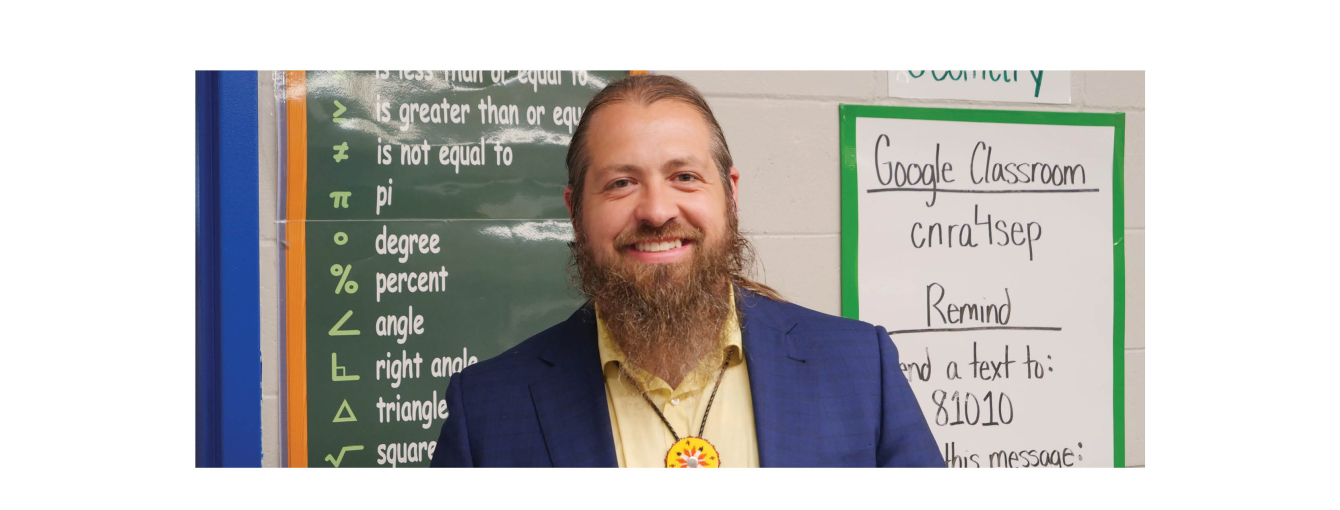
His grandson, Dr. Calvin Krogman, a high school math teacher at Isanti Community School on the Santee Sioux Reservation, shared that story with delegates at NSEA's Delegate Assembly this spring. It was the Lakota spoken “in whispered tones behind closed doors,” Krogman said, because children could be beaten if their teachers heard them speaking it.
Decades later, after Evans suffered a stroke, his ability to use and understand English began to disappear. The language he had been discouraged from speaking as a child did not.
“In his final days, Lakota was all he knew and Lakota was all he understood,” Krogman said.
The effort to silence the language had worked. Evans’ Lakota had not been passed down to the generations gathered around him in his final days.
“His last words echoed in a hospital room among family who had never had the opportunity to know the language,” Krogman said.
For Krogman, a member of NSEA’s Ethnic Minority Affairs Committee (EMAC), that moment became part of a much larger story about what can disappear when a language is interrupted between generations.
More Than Words
In May, Krogman stood before delegates on behalf of EMAC to introduce a new NSEA resolution on preserving generational languages, defined in the resolution as languages spoken in the home other than English.
The resolution calls for access to professional development in cross-linguistic and multilingual education for school personnel and recognizes language preservation as foundational to cultural identity.
Language, the resolution says, connects generations. Through it come family histories, relationships with elders, traditions, stories, knowledge and even the recipes that find their way from one kitchen to the next.
Krogman made that idea tangible.
“It does not matter whether it’s Lakota or Spanish or German or Dutch or Russian,” he told delegates.
Maybe it is a cookbook written in German. An inscription from a great-grandmother in Dutch. A Norwegian family name.
Languages, Krogman said, “give a connection to something that goes far beyond who we are as an individual, but to who we are as a people.”
When the Chain Is Broken
As Nebraska educators prepare to recognize Native American Heritage Month in November, Krogman’s family story underscores what can be lost when a language is silenced and what can be preserved when a new generation is given the opportunity to learn it.
For generations of Native families, however, that chain was not simply allowed to fade. It was deliberately broken.
Federal Indian boarding schools were created as instruments of assimilation, separating Native children from their families, communities, cultures and languages. Nebraska was home to one of them.
In September, EMAC members visited the site of the Genoa Indian Industrial School, which opened in 1884 on former Pawnee Reservation land. Children from more than 40 tribal nations attended the school during its 50 years of operation.
Its mission was explicit: to replace traditional American Indian ways of life with mainstream American culture.
Children, some as young as 4, were removed or coerced away from their families and could remain separated from their communities for years. Students lived under strict, military-style regimentation, harsh discipline and demanding labor.
At least 86 children are known to have died while attending Genoa Indian Industrial School.
Reclaiming What Remains
Tracy Hartman-Bradley, Title VI Indian Education Program Director/NICE TLC with Omaha Public Schools Administrators and an EMAC member, spoke in support of the generational languages resolution at the 2026 Delegate Assembly.
“Language is culture, period,” she told delegates.
Her mother attended a boarding school and speaks her first language fluently. But that language was not fully passed to Hartman-Bradley.
“That wasn’t passed on because it was beaten out of them,” she said.
Christina Running Hawk Ellison, an Oglala Lakota educator with Omaha Public Schools, described another version of the same interruption. Her grandparents and father attended boarding schools. They spoke Lakota fluently when she was young, but she learned only some words.
Today, she uses what she remembers with her own children and in classrooms.
“I try to use what other little pieces” remain,” she told delegates.
Those pieces matter. Preserving a language means more than protecting vocabulary. It can mean restoring relationships between generations and giving young people access to knowledge previous generations were discouraged, punished or prevented from passing along. Increasingly, educators are becoming part of that work.
Hartman-Bradley told delegates that Omaha Public Schools is working toward introducing Indigenous language instruction, with plans for a Ho-Chunk language pilot program in 2027.
It is an effort, she said, to give language back to children.
Delegates adopted Resolution D-14 in May, adding the preservation of generational languages to NSEA’s resolutions.
For Krogman, preserving generational languages is not about keeping something frozen in the past. It is about ensuring that which survived can continue moving forward.
“The value of this resolution is in knowing that no one’s words will die with them,” Krogman said.
When his grandfather lost his English, his Lakota remained. What did not survive intact was the path for those words to reach the generations gathered around him.
A language can hold a story. It can carry a prayer, a recipe, a memory, a way of understanding the world or the last words of someone you love.
And when it is passed from one generation to the next, the words carry more than language. They carry the voices of those who came before - and a legacy for those who will come after.

New Educators
The New Generation of Educators in Nebraska (NewGEN) exists to drive early career educators towards success by fostering membership engagement, advancing teaching excellence through professional development, and creating a network of support through mentorship opportunities and classroom resources.

Join Now
NSEA is here for you. From professional growth opportunities and support, to amplifying your voice in public policy affecting you and your classroom, to providing perks like college debt assistance, NSEA has your future in mind. Learn more and join NSEA now.

The NSEA Children's Fund
NSEA established the Children's Fund in 1994 to fulfill modest and immediate needs of struggling students encountered daily by NSEA members in their workplaces. Find out how you can help a child today.
L.E.A.R.N — Providing valuable learning opportunities for educators: LearnNebraska.org Visit Website